Can You Bring a Corkscrew on a Plane? Carry-On and Checked Bag Rules Explained
Last Updated: April 16, 2026

You can bring a corkscrew on a plane, but the type determines where you pack it. Corkscrews without blades are generally allowed in carry-on luggage. Corkscrews with a foil cutter or knife must be packed in checked bags. Airport security officers make the final decision at screening.
Traveling with wine tools is common for enthusiasts, professionals, and anyone planning to enjoy a bottle at their destination. The challenge is knowing which corkscrews pass airport security and which ones get confiscated.
The rules are simple once you understand one key factor: whether your corkscrew includes a blade.
This guide breaks down exactly what you can bring, what to avoid, and how to travel confidently with the right wine opener.
Key Takeaways
- Corkscrews without blades are generally allowed in carry-on luggage because they do not present a cutting risk at security checkpoints
- Corkscrews with foil cutters, knives, or any sharp edge must be packed in checked luggage to comply with airport security rules
- A waiter’s corkscrew, also known as a wine key, is rarely carry-on safe because it almost always includes a folding blade
- Airport security officers have final discretion, which means even compliant tools can be flagged depending on how they appear during screening
- Choosing a purpose-built, travel-friendly corkscrew reduces the risk of confiscation, delays, or losing a high-quality wine tool
The Quick Answer: Are Corkscrews Allowed on Planes?
Yes, corkscrews are allowed on planes, but the type of corkscrew determines where you can pack it.
- Carry-on bags: Only corkscrews without blades
- Checked luggage: All corkscrews, including those with blades or foil cutters
The key distinction is not the spiral, also called the worm. It is the presence of a cutting component. A small integrated knife or foil cutter is what triggers restrictions at airport security.
This is why two corkscrews of similar size can be treated very differently. A compact, blade-free opener may pass without issue, while a professional wine key is almost always restricted to checked baggage.
Which Corkscrews Are Carry-On Friendly?

Not all corkscrews are equal in the eyes of airport security. The safest carry-on options are those with no sharp edges, no folding blades, and no cutting attachments.
Common carry-on friendly corkscrews:
- Two-prong corkscrews (Ah-So style): These use two thin prongs instead of a spiral and have no blade, making them one of the safest travel options
- Basic spiral-only corkscrews: Simple designs with just a worm and handle, without any additional tools
- Compact lever corkscrews without blades: Some small lever-style openers are designed specifically for travel and avoid integrated cutters
- Minimalist travel corkscrews: Purpose-built designs that focus on portability and compliance rather than multi-functionality
These tools are effective for opening wine while staying within carry-on guidelines. They eliminate the main issue that causes confiscation, which is the blade.
Even so, airport screening is not purely rule-based. Security officers evaluate items visually and contextually. A tool that appears sharp, complex, or unfamiliar may still be flagged.
For that reason, the safest strategy is to choose a corkscrew that is clearly non-threatening in both design and appearance.
Which Corkscrews Should Go in Checked Luggage?
If your corkscrew includes any cutting element, it should be placed in checked luggage without exception.
Corkscrews that belong in checked bags:
- Waiter’s corkscrew (wine key): The most common professional tool, typically featuring a folding foil cutter blade
- Double-hinged sommelier corkscrews: High-performance tools used in restaurants and wineries, almost always equipped with blades
- Multi-tool wine openers: Tools that combine a corkscrew with knives, bottle openers, or other functions
- Corkscrews with integrated foil cutters or knives: Any design that includes a cutting edge, even if it is small
These tools are highly effective and preferred by professionals, but they are not suitable for carry-on because of their blade components.
Checked luggage is not only compliant but also practical. It allows you to bring your preferred tool without risking confiscation at the checkpoint.
Why the Blade Matters More Than the Spiral
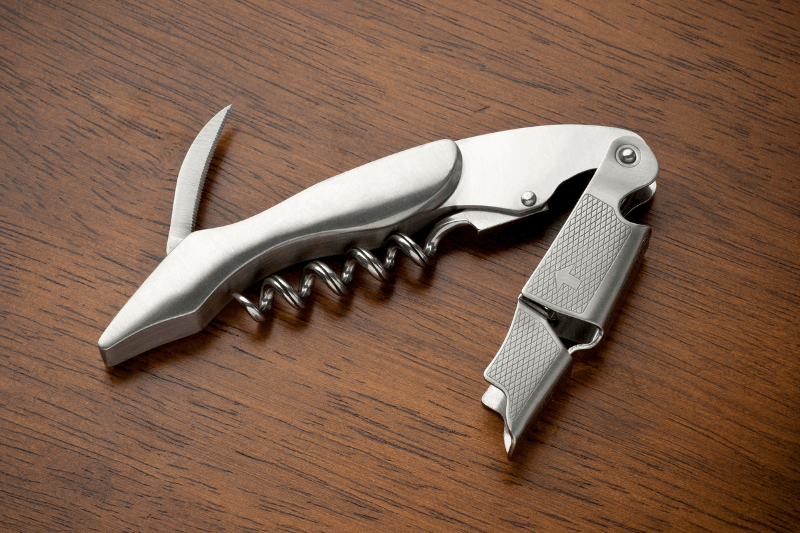
The spiral, or worm, is designed to extract a cork. It is not considered a security concern.
The restriction comes from the foil cutter or knife, which is designed to cut through foil capsules. Even though it is small, it is still classified as a sharp object.
A waiter’s corkscrew illustrates this clearly. It is compact, efficient, and widely used in the wine industry, yet the folding blade makes it unsuitable for carry-on.
This distinction explains why:
- A simple corkscrew passes through security
- A professional wine key gets stopped
Understanding this difference allows you to evaluate any corkscrew quickly. If it includes a blade, it belongs in checked luggage. If it does not, it has a strong chance of being allowed in your carry-on.
Carry-On vs Checked Bag Comparison
| Corkscrew Type | Carry-On Allowed | Checked Bag Allowed | Notes |
| Two-prong (Ah-So) | Yes | Yes | No blade, low risk |
| Basic spiral corkscrew | Yes | Yes | Simple and compliant |
| Lever corkscrew (no blade) | Yes | Yes | Must be blade-free |
| Waiter’s corkscrew (wine key) | No | Yes | Contains foil cutter |
| Multi-tool corkscrew | No | Yes | Includes blade or knife |
| Electric wine opener | Usually yes | Yes | Check battery restrictions |
Best Corkscrew Styles for Travel
Choosing the right corkscrew depends on your travel style, your luggage setup, and how important convenience is at your destination.
Carry-on only travelers
If you are traveling without checked luggage, your best option is a blade-free corkscrew. Two-prong and minimalist designs offer reliability without triggering security concerns. These are ideal for short trips, business travel, or light packing.
Wine professionals and enthusiasts
For performance and control, a waiter’s corkscrew remains the gold standard. However, it should always be packed in checked luggage. This ensures you can use your preferred tool without compromising compliance.
Vacation and leisure travelers
A compact, durable corkscrew without a blade provides the best balance. It is easy to pack, easy to use, and unlikely to cause issues at the airport. This is often the most practical choice for rentals, picnics, or casual wine experiences.
Gifting or event travel
If you are bringing a premium corkscrew or a branded wine tool, protection becomes just as important as compliance. Place it in checked luggage, use a protective case, and avoid loose packing to prevent damage or loss.
A well-chosen travel corkscrew should be compact, dependable, and clearly designed without sharp components. This reduces uncertainty at airport security and ensures your wine experience starts smoothly the moment you arrive.
How to Pack a Corkscrew Safely for Air Travel
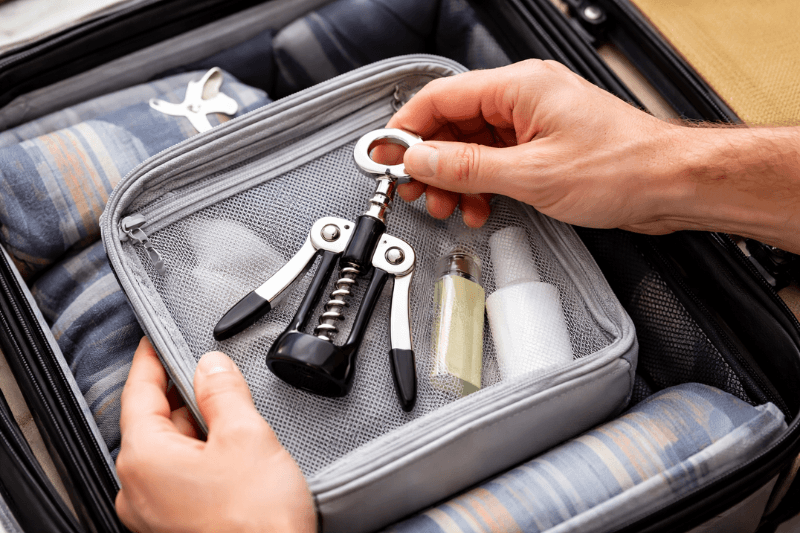
Packing your corkscrew properly is just as important as choosing the right one. A well-packed tool protects your luggage, avoids unnecessary scrutiny at security, and ensures your corkscrew arrives in perfect condition.
Start by securing all moving parts. Hinges, levers, and especially blades should be fully folded and locked into place. A partially open tool can catch on fabric, damage other items, or raise concerns during inspection.
Whenever possible, store your corkscrew in a protective pouch or case. This keeps it contained, prevents scratches, and makes it easier for security officers to identify the item quickly. If you do not have a case, wrapping it in clothing or a soft cloth provides a similar level of protection.
Placement inside your luggage also matters. Position the corkscrew in a padded section near the center of your bag rather than along the edges. This reduces movement during transit and protects both the tool and surrounding items. Keep it away from fragile objects like glassware or bottles, as even minor impacts can cause damage.
For corkscrews with blades, checked luggage is not only required but also the safest option. It eliminates the risk of confiscation and prevents potential damage or injury during handling.
International Flights and Airline Differences
Corkscrew rules become less predictable when you travel internationally. Security policies are set by individual countries, and enforcement can vary between airports, even within the same region.
A corkscrew that passes through one airport may be flagged at another. This is especially true for tools that include multiple functions or resemble professional equipment.
Before traveling internationally, take a few precautionary steps:
- Check the security guidelines for your departure airport
- Review your airline’s prohibited items list
- Consider the rules that will apply on your return trip
When there is any uncertainty, placing your corkscrew in checked luggage is the safest approach. It removes guesswork and avoids last-minute issues at the checkpoint.
What Happens If Airport Security Flags Your Corkscrew?
If your corkscrew is flagged during screening, the outcome depends on timing and airport procedures. Security officers assess items individually, and decisions are often made on the spot.
In most cases, you will either need to surrender the item or find a way to move it into checked luggage before the cutoff time. Occasionally, an item may go through additional inspection, but this does not guarantee it will be allowed.
The key point is that once you reach the checkpoint, your options are limited. If your corkscrew is not compliant and you cannot check it, you will likely lose it.
The most reliable way to avoid this situation is to plan ahead. Choose the right corkscrew for your travel style and pack it in the appropriate place from the beginning.
Travel Smart with the Right Corkscrew
You can bring a corkscrew on a plane, but success comes down to one simple detail: whether it has a blade.
Blade-free corkscrews are usually fine for carry-on, while anything with a foil cutter or knife belongs in checked luggage. Get this right, and you avoid delays, awkward moments at security, and the risk of losing a good tool. If you travel often or just want a smoother experience, it helps to have a corkscrew that is made with portability in mind.
Wine-n-Gear offers corkscrews, corkscrew packaging, and corkscrew sets, along with other wine accessories and tools designed for both convenience and performance, so you can pack confidently and enjoy your wine wherever you land.
FAQs
Can I bring a waiter’s corkscrew on a plane?
A waiter’s corkscrew, also known as a wine key, is not allowed in carry-on luggage because it almost always includes a folding foil cutter blade. Even though the blade is small, it still falls under sharp object restrictions. To avoid confiscation, it should always be packed in checked baggage.
Can I bring a wine key in my carry-on?
Most wine keys are not carry-on safe because they include a blade. However, if you have a version without a foil cutter, it may be allowed. Keep in mind that security officers make the final decision, so even blade-free tools should be simple and clearly non-sharp in design.
Can I bring a foil cutter on a plane?
Foil cutters with sharp edges are generally not permitted in carry-on luggage. While they may seem harmless, they are still classified as cutting tools. The safest option is to pack them in checked baggage or leave them at home if you are traveling with only a carry-on.
Can I bring an electric wine opener on a plane?
Electric wine openers are typically allowed in both carry-on and checked luggage. The main consideration is the battery. If the opener uses lithium batteries, it is best to carry it in your carry-on bag, as many airlines restrict lithium batteries in checked luggage. Always check airline-specific battery rules before traveling.
Are corkscrews allowed on international flights?
Yes, corkscrews are allowed on international flights, but enforcement varies by country and airport. A corkscrew that passes through one airport may be flagged in another. For tools with blades, checked luggage is the safest and most consistent option across different regions.
What is the best corkscrew for travel?
The best corkscrew for travel is compact, durable, and free of any blade. Two-prong corkscrews and minimalist designs are the most reliable for carry-on use. If you prefer a professional tool like a waiter’s corkscrew, plan to pack it in checked luggage.